
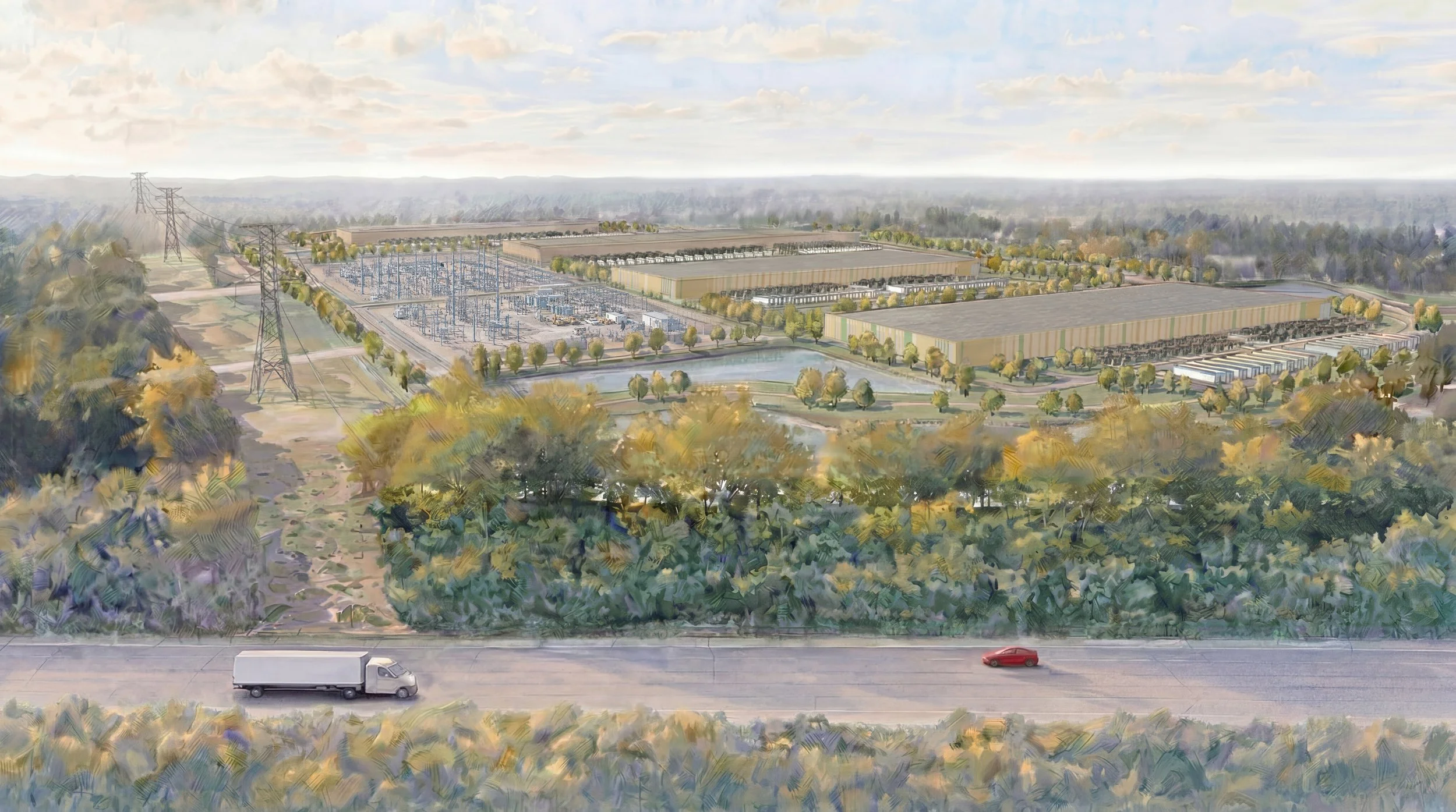
Festus Leads the Way In Growth & Innovation
PROJECT OVERVIEW
CRG is developing a data center in Festus, Missouri. Data centers are the invisible backbone of our digital lives. Every time we stream a show, back up photos, shop online, or use AI tools, the work is done in a data center. These specialized facilities power the apps and services we rely on 24/7.
The plan we're sharing here reflects what we've heard from the community and is meaningfully smaller than our earlier concepts.
The facility is designed for approximately 600 megawatts, which is approximately 40% smaller than CRG’s original concept. The development will include single-story buildings and will use closed-loop cooling.
At more than $6 billion, the project represents the largest private investment in the history of Festus and Jefferson County.
As this moves forward, CRG is committed to operating safely, managing our environmental footprint responsibly, and keeping the community informed.
View the latest presentation delivered on Tuesday, June 29, 2026
Your Questions, Answered
We listened to the community and made improvements to this project.
Here are answers to the questions we hear most.
Project Overview
-
Our initial conceptual plan contemplated a 1-gigawatt campus, with 12 two-story buildings. We are choosing not to build that. Instead, our revised conceptual plan is approximately 600 megawatts, with 4 single-story buildings and larger setbacks from residential neighborhoods. We made these changes after hearing the community’s concerns. In deciding what to put forward, we weighed building to the full scale the zoning code and development agreement allow (a denser site plan with taller buildings) against a smaller-footprint alternative and chose the smaller one.
-
The 40% reduction refers to power capacity — roughly 1 gigawatt down to about 600 megawatts — not to dollars. The $6 billion has always been described as a minimum initial investment in construction costs and the personal property (equipment) inside the buildings. Moving to fewer, single-story buildings with greater setbacks and more preserved land changed the scale of the campus. However, data center costs are driven far more by the equipment inside the buildings than by the buildings themselves, and as the cost of that equipment per megawatt has risen significantly, we still expect this to be at least a $6 billion investment.
-
No groundbreaking or opening date has been set. The project is still working through the site planning process, and construction cannot begin until that process is complete.
-
We filed a single land disturbance permit for modest clearing to perform soils (geotechnical) testing. That is the only permit filed to date. We have since held off on that testing until the site plan is further along, and no groundbreaking or construction date has been set.
-
We understand this is important for the community. At this time, we are actively discussing the development with multiple users. We will share end-user updates at the appropriate time. The project could follow one of two paths: a single user occupying the campus, or a multi-tenant approach in which CRG delivers a leased “powered shell” serving several operators. We will share updates as plans are finalized. What we can confirm is that CRG is the developer, Clayco is the general contractor, and both are committed to Festus regardless of the tenant’s name.
-
This is an enterprise-scale data center — secured buildings housing servers and networking equipment that support cloud computing. Data centers are the invisible backbone of our digital lives. Every time we stream a show, back up photos, shop online, or use AI tools, the work is done in a data center. These specialized facilities power the apps and services we rely on 24/7.
-
The nearest building sits about 1,200 feet from the adjacent property, about four football fields away. The buildings are only one story tall and sit behind a preserved ridgeline and tree buffer. In addition to the trees we will be preserving, there will be significant landscaping, so most neighbors will not see the buildings.
-
Specific parking counts are determined during final design and the permitting process, which will include a traffic impact study. As design elements are finalized, they will be made available to the public and added to FestusForward.com.
Once operating, data centers generate relatively low daily traffic compared with office, traditional industrial, retail, or large residential developments, especially due to multiple shifts.
-
While work will need to occur to create an entrance off Old England Road, construction traffic is otherwise planned to use designated routes, not residential streets. We will fund the traffic improvements required by the development agreement, including turn and acceleration / deceleration lanes on Highway 67, in coordination with MoDOT.
-
We are preserving approximately 188 acres, more than half of the land. This protects trees, streams, and the ridge by Ashford Place.
The environmental study located gravesites in the preserved land. Our site plan is designed to avoid them, and any work in the vicinity would follow Missouri law governing the protection of burial sites.
-
The property sits at the boundary between two fire districts — the City of Festus and the Hematite Fire Protection District. Where that boundary falls is a question for those two districts to resolve; CRG is not a party to it. As the site plans are finalized, we will coordinate with the applicable district or districts so that adequate fire protection and emergency service are in place for the entire property.
-
As announced at our June 29, 2026, presentation, if at or after 20 years from the start of operations, the site is abandoned — meaning operations have ceased, the property is not being repositioned for productive use, and it has fallen into disrepair or non-compliance — the City may draw on a $10 million bond or letter of credit posted by the developer to help reposition the asset.
Data centers are long-lived assets. The 15-year figure sometimes cited likely refers to the refresh cycle for servers and IT equipment inside the building, not the life of the building or the campus. Facilities are routinely re-equipped and continue operating for decades, which is why the decommissioning protection is structured around abandonment rather than a fixed end date.
-
As job opportunities become available, we will keep the community informed through FestusForward.com and our public communications channels.
-
There are no non-disclosure agreements in place between the City of Festus and CRG, in either direction. Additionally, we can confirm that there are no NDAs with any public body or agency involved with this development including Jefferson County.
-
We continue to hold regular online events where residents can hear directly from the project team, learn more about the current conceptual plan, and have their questions answered. You can view the Events & Webinars section of the website for the schedule and registration information.
Please note that the webinars are in addition to the in-person meeting we’ll be holding as part of the permitting process.
-
The voluntary buyout includes two groups of homes: (1) the 12 homes referenced in the Development Agreement (11 homes on Glenkee Court and 1 home north of the project site), and (2) additional homes that are located within one thousand feet of an active data center building, determined upon final building placement. This threshold is set by the Development Agreement between CRG and the City of Festus, which is a public document. We have identified additional homes south of Highway 67 that fall within that 1,000-foot radius under the current conceptual plan. As the site plan is finalized, we will confirm the full list of eligible homes and notify each owner directly. Any home that remains within 1,000 feet of an active data center building at that point is eligible on the same terms.
For every eligible home, the terms are the same. CRG will honor the voluntary buyout at fair market value as of June 1, 2025 (or a later date at the homeowner's election), plus a 15% premium and a $10,000 moving allowance to help offset financing and moving costs. The premium is intended to help offset the higher interest rates a homeowner may face when financing a replacement home.
The program is entirely voluntary. It commences on the issuance of the first permit for the project and remains open for 36 months after issuance of an occupancy permit for a non-administrative data center building.Homes purchased through the buyout program are resold on the open market. They will not sit abandoned or be used as rental housing.
-
Where site preparation requires rock excavation, any blasting is performed by a licensed contractor in accordance with Missouri regulations and established industry standards. Each blast is individually engineered to use only the energy needed to fracture rock, minimizing vibration and air overpressure.
Several safeguards are built into the process: pre-blast surveys of nearby homes — offered at no cost, at each homeowner’s election — that document and photograph existing conditions (including foundations) to establish a baseline; independent, third-party seismographs that monitor ground vibration and air overpressure at every blast to keep it within state limits, with records maintained throughout; and engineered blast design and established safety zones that keep material within the excavation area.
If a homeowner believes blasting has caused damage, the pre-blast survey and seismograph records provide an objective baseline, and claims are reviewed against that documentation.
-
We looked at sites throughout this area of Missouri. This site was specifically chosen for its access to excellent electric infrastructure, transportation corridors, and the strong local workforce. Additionally, this site has utilities and emergency services that are all able to serve the site.
-
"Conceptual" indicates the plan reflects our design at this phase of the process — it is not a construction document. Architects and engineers label drawings by design phase; it's a professional and legal standard, and removing it would be inaccurate rather than reassuring.
What that label does not mean is that the plan is open-ended. The setbacks, access points, landscape buffers, and layout shown are exactly what we are planning toward. Once approved, those become binding conditions of approval, and any material change to those commitments brings us back before the City.
Economic benefits
-
More than $6 billion in private investment, plus $40 million over 10 years in community benefit payments, and no real estate property tax abatement. The project is expected to create approximately 1,000 construction jobs at peak and more than 200 permanent jobs with pay above the county average, with a focus on hiring local workers.
-
Beyond the $40 million in community benefit payments over 10 years, the project is projected to generate substantial ongoing revenue across all of the local taxing districts — the City of Festus, Jefferson County, the Festus R-VI School District, the Joachim-Plattin Ambulance District, and Jefferson College — as well as the State of Missouri.
A few things about the tax structure are worth knowing:
There is no real-property tax abatement. The project pays full real property taxes.
The electric-utility gross-receipts tax is not abated, and there is no cap on gross receipts.
The personal property (equipment) portion phases down over 25 years, with guaranteed PILOT (payment in lieu of taxes) payments to the City in later years.
Taken together, we have described the combined property taxes, gross-receipts taxes, PILOT payments, and community benefit payments as totaling hundreds of millions of dollars over 25 years.
For residents who want to review the underlying analysis, the City hired MarksNelson (now Springline Advisory) to complete an economic benefit analysis of the $6B investment and a 1G campus. That analysis can be found on the City’s website, which we’ve linked here. This is the best source to review. That study shows that, even with the requested abatement, the anticipated taxes for Festus R-VI School District are $581,224,197.
As the site plan is finalized, we will be able to confirm the estimated economic benefit.
-
Several major operators publish information about their community programs, including Microsoft (local.microsoft.com), Meta (datacenters.atmeta.com), Amazon Web Services (AWS), and Google's Data Center Community Grants Program (datacenters.google).
Oversight & accountability
-
Multiple independent agencies review and regulate different aspects of the project, including, but not limited to:
Missouri Public Service Commission (PSC)
Midcontinent Independent System Operator (MISO)
Missouri Department of Natural Resources
U.S. Environmental Protection Agency (EPA)
U.S. Army Corps of Engineers
Jefferson County Water Authority
City of Festus
Festus Fire Department
Water
-
We have updated our cooling system to be “closed loop, dry-type cooling” that rejects heat to the outdoor environment and does not rely on evaporation. Because the cooling water remains sealed within piping and no evaporative process is involved, the system will not require a continuous water supply and will not produce wastewater during normal operation. Any water usage or discharge will be overseen by the City of Festus, Jefferson County Water Authority, and the Missouri Department of Natural Resources.
No private wells will be utilized for this project.
-
Based on preliminary engineering estimates, day-to-day operational water use is expected to be approximately 30,000–50,000 gallons per day. Because the cooling system is a sealed dry closed loop, this water is not used for cooling. It supports building operations — restrooms, kitchen, and routine facility needs — plus occasional makeup fluid for the sealed loop. Separately, fire protection systems require the availability of roughly 300,000 gallons per day of fire flow capacity. Importantly, fire flow is a measure of the pressure and capacity that must be available in the event of an emergency — it is not water the facility consumes daily and should not be added to operational use figures. A new city water storage tank on site is also under evaluation. These figures are preliminary and will be refined as engineering advances; the finalized water agreement with the City will be a public document.
-
Yes. CRG has been working with the City and Burns & McDonnell on the water agreement, which is targeted for completion by October 2026 under the development agreement. The finalized agreement will be a public document, and we will post it on this website once it is available.
-
Small amounts of chemicals will be added sporadically to maintain cooling water quality, and support optimal operation and longevity of the cooling infrastructure. This approach is standard practice at other facilities using the same closed-loop cooling method such as hotels, universities, airports, offices, and shopping malls. As noted, because the water remains contained within sealed piping, neither the cooling water nor its treatment chemicals will enter the sanitary sewer system during routine operation.
We are committed to selecting water treatment chemicals that are both project appropriate and locally compliant. For instances when discharge is required, we will coordinate with the sewer district to confirm the chemicals meet all applicable discharge requirements.
Additionally, leak detection sensors will be incorporated at strategic points throughout the cooling infrastructure to promptly identify and address any potential leaks before they escalate. Because of the upfront coordination with the sewer district, even in the unlikely event that a leak allows cooling water and chemicals to reach the sanitary system, the local wastewater treatment plant will be able to accommodate them without adverse impact.
Electricity
-
We pay for our own power and equipment, not Festus residents. Missouri law requires data centers to cover their own energy costs. Large load customers also fund the transmission and generation upgrades that make power more reliable for everyone.
Our commitment: If the project’s electricity use exceeds 1 GW, we will fund a $3 million payment to the City for residential electric rate relief. Under the current conceptual plan we do not expect the campus to reach 1 gigawatt. This commitment is a backstop in the event the project ever grows beyond what is contemplated today.
-
CRG has no plans involving on-site small modular reactors or on-site nuclear generation. All power will be supplied through Ameren Missouri — there is no on-site power plant, only backup generators for outages and testing.
-
That's determined by Ameren in coordination with the PSC and MISO — they identify the specific transmission and generation upgrades, and under the large-load rules those costs are funded by us as the customer, not by residents.
Noise
-
A full sound study will be done before any permit is given. We will also conduct post-build confirmation studies and ongoing monitoring, per the Festus Data Center Ordinance, to ensure we meet or beat the City’s sound regulations.
-
The generators on this site are backup only; they run during utility outages and for brief, City-coordinated testing. These are not a primary power source. We've committed to Tier 4 standards, the most stringent EPA tier. Federal rules separately cap non-emergency run hours.
Before operating, the project must obtain state and federal air permits overseen by the Missouri Department of Natural Resources and the U.S. EPA. The final number of generator units depends on the facility's final design and the end user's requirements.