
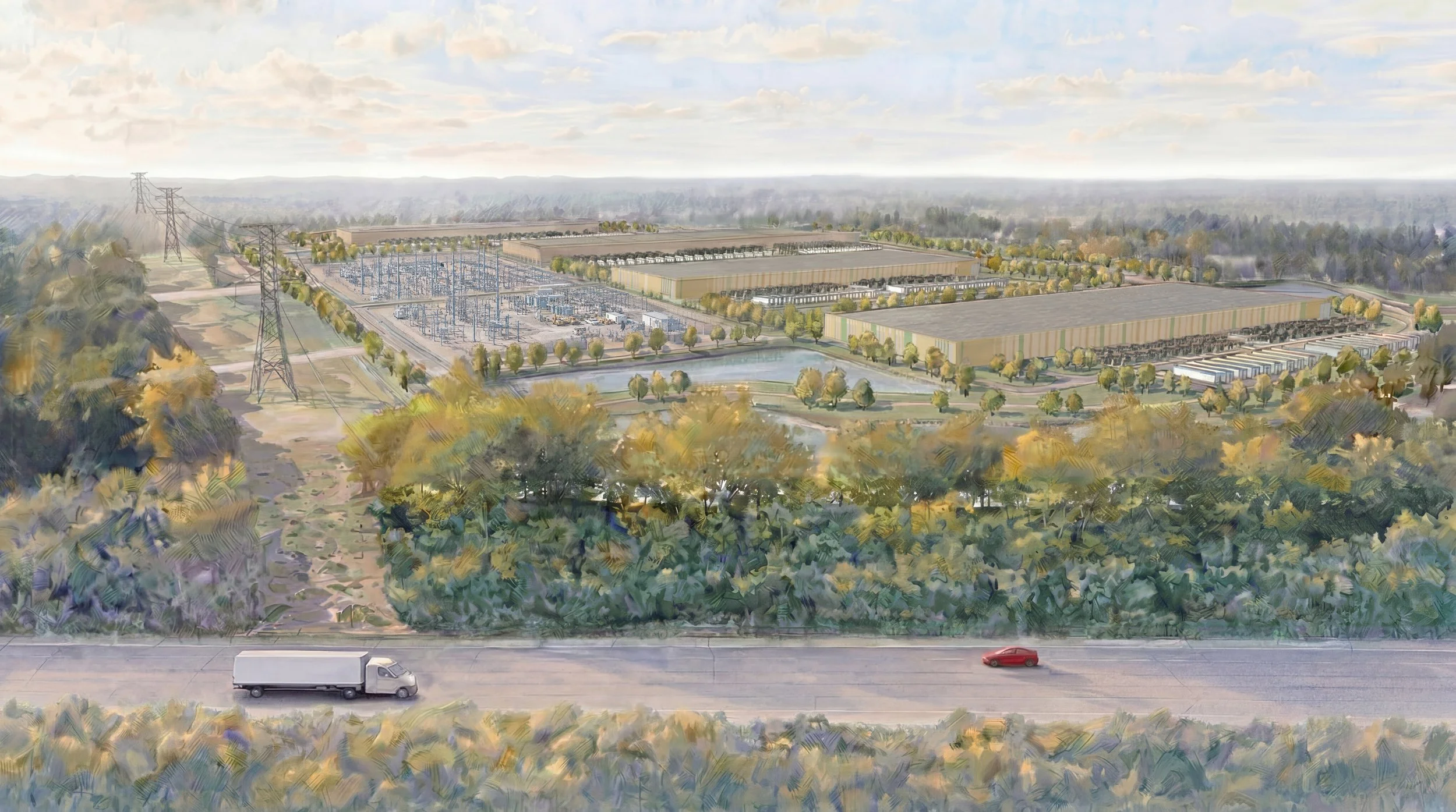
Festus Leads the Way In Growth & Innovation
PROJECT OVERVIEW
CRG is developing a data center in Festus, Missouri. Data centers are the invisible backbone of our digital lives. Every time we stream a show, back up photos, shop online, or use AI tools, the work is done in a data center. These specialized facilities power the apps and services we rely on 24/7.
The plan we're sharing here reflects what we've heard from the community and is meaningfully smaller than our earlier concepts.
The facility is designed for approximately 600 megawatts, which is approximately 40% smaller than CRG’s original concept. The development will include single-story buildings and will use closed-loop cooling.
At more than $6 billion, the project represents the largest private investment in the history of Festus and Jefferson County.
As this moves forward, CRG is committed to operating safely, managing our environmental footprint responsibly, and keeping the community informed.
View the latest presentation delivered on Tuesday, June 29, 2026
Your Questions, Answered
We listened to the community and made improvements to this project.
Here are answers to the questions we hear most.
Project Overview
-
Our initial conceptual plan contemplated a 1-gigawatt campus, with 12 two-story buildings. We are choosing not to build that. Instead, our revised conceptual plan is approximately 600 megawatts, with 4 single-story buildings and larger setbacks from residential neighborhoods. We made these changes after hearing the community's concerns.
-
No groundbreaking or opening date has been set. The project is still working through the site planning process, and construction cannot begin until that process is complete.
-
We understand this is important for the community. We have interest from a lot of users. We will share that information at the appropriate time. What we can confirm is that CRG is the developer, Clayco is the general contractor, and both are committed to Festus regardless of the tenant’s name.
-
This is an enterprise-scale data center — secured buildings housing servers and networking equipment that support cloud computing. Data centers are the invisible backbone of our digital lives. Every time we stream a show, back up photos, shop online, or use AI tools, the work is done in a data center. These specialized facilities power the apps and services we rely on 24/7.
-
The nearest building sits about 1,200 feet from the adjacent property, more than three football fields away. The buildings are only one story tall and sit behind a preserved ridgeline and tree buffer. In addition to the trees we will be preserving, there will be significant landscaping, so most neighbors will not see the buildings.
-
Specific parking counts are determined during final design and the permitting process. As design elements are finalized, they will be made available to the public and added to FestusForward.com.
-
We are preserving approximately 188 acres, more than half of the land. That protects trees, streams, and the ridge by Ashford Place.
The environmental study located gravesites in the preserved land. They will not be disturbed.
-
As we finalize the site plans, we will be coordinating with the applicable fire districts to ensure adequate fire protection and emergency service are in place for the entire property. We want to get this right and will work with the districts as the plans advance.
-
As announced at our June 29 presentation, if at or after 20 years from the start of operations, the site is abandoned — meaning operations have ceased, the property is not being repositioned for productive use, and it has fallen into disrepair or non-compliance — the City may draw on a $10 million bond or letter of credit posted by the developer to help reposition the asset.
-
The 40% reduction refers to power capacity — roughly 1 gigawatt down to about 600 megawatts — not to dollars. The $6 billion has always been described as a minimum initial investment in construction costs and the personal property (equipment) inside the buildings. Moving to fewer, single-story buildings with greater setbacks and more preserved land changed the scale of the campus, but we still expect this to be at least a $6 billion investment.
-
As job opportunities become available, we will keep the community informed through FestusForward.com and our public communications channels.
-
There are no non-disclosure agreements in place between the City of Festus and CRG, in either direction. Additionally, we can confirm that there are no NDAs with any public body or agency involved with this development including Jefferson County.
-
We plan to hold a series of regular online events where residents can hear directly from the project team, learn more about the current conceptual plan, and have their questions answered. We will update FestusForward.com with schedule and registration information as they become available.
Please note that the webinars are in addition to the in-person meeting we’ll be holding as part of the permitting process.
Economic benefits
-
More than $6 billion in private investment, plus $40 million over 10 years in community benefit payments, and no real estate property tax abatement. The project is expected to create approximately 1,000 construction jobs at peak and more than 200 permanent jobs with pay above the county average, with a focus on hiring local workers.
-
Beyond the $40 million in community benefit payments over 10 years, the project is projected to generate substantial ongoing revenue across all of the local taxing districts — the City of Festus, Jefferson County, the Festus R-VI School District, the Joachim-Plattin Ambulance District, and Jefferson College — as well as the State of Missouri.
A few things about the tax structure are worth knowing:
There is no real-property tax abatement. The project pays full real property taxes.
The electric-utility gross-receipts tax is not abated, and there is no cap on gross receipts.
The personal property (equipment) portion phases down over 25 years, with guaranteed PILOT (payment in lieu of taxes) payments to the City in later years.
Taken together, we have described the combined property taxes, gross-receipts taxes, PILOT payments, and community benefit payments as totaling hundreds of millions of dollars over 25 years.
For residents who want to review the underlying analysis, the City of Festus commissioned an independent economic-benefit study prepared by MarksNelson (now Springline Advisory). That study is available on the City of Festus website, and it is the best single source for the details behind these figures. One note while reading: the study was prepared for a $6 billion, 1-gigawatt campus.
As the site plan is finalized, we will be able to confirm the estimated economic benefit and share more specific figures.
-
Several major operators publish information about their community programs, including Microsoft (local.microsoft.com), Meta (datacenters.atmeta.com), Amazon Web Services (AWS), and Google's Data Center Community Grants Program (datacenters.google).
Here is a list of specific published resources.Microsoft: Microsoft's Datacenter Community Pledge
Microsoft: Microsoft datacenters in West Des Moines, IA
Microsoft: Microsoft datacenters in Your Community
Microsoft: Growing with communities: How Microsoft datacenters contribute to growth
Microsoft: How closed-loop cooling works in Microsoft's datacenters
Amazon: Why does AI use water?
Google: Inside Google's data centers: Our approach to responsible water use
Google: How can Google data centers support reliable electricity?
Oversight & accountability
-
Multiple independent agencies review and regulate different aspects of the project, including:
Missouri Public Service Commission (PSC)
Midcontinent Independent System Operator (MISO)
Missouri Department of Natural Resources
U.S. Environmental Protection Agency (EPA)
U.S. Army Corps of Engineers
Jefferson County Water Authority
City of Festus
Festus Fire Department
Water, Energy & Sound
-
We have updated our cooling system to be "closed loop," meaning it reuses the same water over and over instead of pulling in new water, and it produces little to no wastewater discharge. Any water usage or discharge will be overseen by the City of Festus, Jefferson County Water Authority, and the Missouri Department of Natural Resources.
No private wells will be utilized for this project. -
We pay for our own power and equipment, not Festus residents. Missouri law requires data centers to cover their own energy costs. Large load customers also fund the transmission and generation upgrades that make power more reliable for everyone.
Our commitment: If the project’s electricity use exceeds 1 GW, we will fund a $3 million payment to the City for residential electric rate relief. -
CRG has no plans involving on-site small modular reactors or on-site nuclear generation. All power will be supplied through Ameren Missouri — there is no on-site power plant, only backup generators for outages and testing.
-
A full sound study will be done before any permit is given. We will also conduct post-build confirmation studies and ongoing monitoring, per the Festus Data Center Ordinance, to ensure we meet or beat the City’s sound regulations.
-
The generators on this site are backup only; they run during utility outages and for brief, City-coordinated testing. These are not a primary power source. We've committed to Tier 4 standards, the most stringent EPA tier. Federal rules separately cap non-emergency run hours.
Before operating, the project must obtain state and federal air permits overseen by the Missouri Department of Natural Resources and the U.S. EPA. The final number of generator units depends on the facility's final design and the end user's requirements.